
College administrators just can’t seem to learn their lesson. Last July, the University of California agreed to a $6.45 million settlement to resolve a lawsuit alleging that the university violated Jewish students’ constitutional rights by failing to ensure their equal access to campus. Now one of the UC’s premier campuses is again embroiled in controversy for violating the constitutional rights of another marginalized campus group—conservatives.
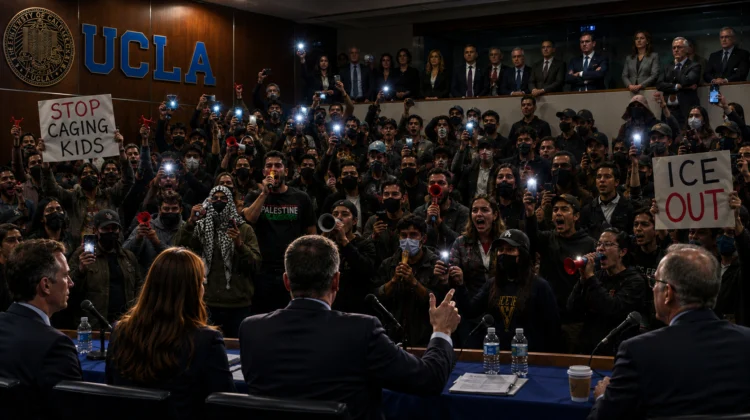
On April 21st, the UCLA Federalist Society, a conservative law student association, held an event featuring Department of Homeland Security General Counsel James Percival. The event drew an angry and raucous crowd of approximately 150 protestors who repeatedly disrupted the event and its speakers by shouting epithets, blasting alarms and ringtones from their phones, clicking pens and tapping on desks, and heckling DHS Counsel Percival and the other speakers on stage.
“Truly abhorrent and unimaginable behavior today at the @FedSocUCLA event that hosted a @DHSgov lawyer,” commented account YitzyFrankel who posted a video highlighting misbehavior at the event on X. “Leftist students repeatedly disrupted the event, yelled profanities, shouted, made their phones ping incessantly, and eventually stormed out to a rally that violated all time, place, and manner restrictions.”
“These students can’t handle @FedSoc event about the law, but will remain students at @UCLA_Law and eventually be admitted to the Bar,” Frankel added. “It is a damning indictment on higher education that students behave so despicably.”
Protestors in the audience can be seen in the video holding profane signs including those reading, “Fuck you loser,” “Stop caging kids,” “How’s Trump’s cock taste,” and “ICE out.”
While the event was able to proceed despite the deliberate distractions, the attempt to silence free speech on a public university campus—by law students no less—illustrates the total lack of respect for viewpoint diversity that persists at UCLA.
“We did our best to have a thoughtful discussion, unfortunately, some audience members were not there to have such a discussion, but instead were there to disrupt the event,” described Pepperdine Law Professor Greg McNeal, who served as a moderator at the event.
When challenged by conservative media outlets to explain the abhorrent conduct of the protestors, UCLA School of Law Dean Michael Waterstone issued a bland statement claiming that protestors who disrupted the event “were issued warnings and were either escorted out or left of their own accord.” He added that “UCLA School of Law is reviewing all policies and will take necessary steps to ensure student groups can host speakers in an environment of civil engagement.”
But when outraged members of the UCLA Federalist Society took the matter into their own hands and attempted to identify the students who illegally disrupted their event, the university’s blasé attitude suddenly disappeared.
On April 22, the day after the event, UCLA’s Assistant Dean for Student Affairs Bayrex Martí sent an email to Federalist Society President Matthew Weinberg cautioning him that publicly identifying the disruptive protestors could lead to disciplinary action against his organization and its members.
“I have also seen requests online to identify students in the audience who are visible in video recordings,” Martí wrote. “I would strongly encourage you and other organizers to not disclose those details.”
If the names of protestors were shared, and those individuals were threatened or harassed as a result, Martí claimed that the Federalist Society would then be responsible for this “reasonably predictable” result.
“If that information is shared despite the tenor of some online commentary, and an implicated student reports behavior from anyone that falls under prohibited behavior per the Student Code of Conduct, the student organization and/or individual students could be connected to it (the allegation being that the outcome was reasonably predictable when the names were disclosed) and subjected to campus processes,” the UCLA Assistant Dean wrote, making the threat of university discipline clear.
There’s just one slight problem with the Dean’s threat—it is blatantly unconstitutional (something the administrators at UCLA School of Law surely ought to know).
The UCLA Federalist Society shared the threatening email with the Foundation for Individual Rights and Expression (FIRE) which sent an “Urgent” missive to UCLA School of Law Dean Waterstone cautioning him that the university was running afoul of the First Amendment.
“The First Amendment protects the right of private individuals and groups to publish truthful information, including the names of other private individuals depicted in publicly available videos, from both prior restraint and punishment,” explained FIRE’s letter. “Students and other audience members attending the April 21 event had no reasonable expectation of privacy regarding their attendance or conduct at the event.”
“As painful as online criticism may be at times, UCLA may not restrict protected speech merely to shield student protesters from the consequences of their actions, including criticism by students, faculty, or the broader community,” the letter continued.
The letter also pointed out yet another issue with the university’s response—viewpoint discrimination. It turns out some of the angry protestors turned to social media to publicly identify and name members of the Federalist Society who hosted the event. Yet in that instance, the university took zero action to protect the conservative law students from potential threats.
“First of all, identifying the names of people who attend a public event is 100% protected speech. You don’t have a right to anonymity in public,” FIRE Executive Vice President Nico Perrino wrote on X.
“Second, enough with these double standards. Threatening only one side with punishment for engaging in the same (protected) expression as the other side is viewpoint discrimination,” Perrino added.
After receiving FIRE’s letter, Dean Marti attempted to walk back his remarks about potential disciplinary action—but didn’t eliminate the possibility that the university could get involved if the naming of protestors led to further conflict.
“I was not saying that in this situation you sharing the names of students who attended the event is prohibited by the UCLA Student Conduct Code,” Marti wrote to Federalist Society President Weinberg. “I only meant to flag that if those students were later targeted or subjected to misconduct, they might respond to that conduct.”
“UCLA Law students have not been given unequivocal assurance that UCLA will not punish them for identifying students who disrupted their event, and as a public institution bound by the First Amendment, UCLA’s response is unacceptable,” FIRE attorney Jessie Appleby stated in an email following this response.
Given the University of California’s dismal history of trampling on student rights, no one should be surprised.
Leave a Reply